
An opinion piece from a Canadian hockey fan.
On Feb. 22, 2026, Jack Hughes buried the golden goal in Milan, Connor Hellebuyck finished off a 41-save night, and a room full of American stars piled onto the ice after beating Canada 2-1 in overtime for the country’s first men’s Olympic hockey gold since 1980.
Within eight months, three of them had asked out of the only NHL organizations they’d ever played for. And one of the biggest names on that roster was already gone from Canada before the tournament even started.
Quinn Hughes is in Minnesota. Brady Tkachuk is in Florida. Connor Hellebuyck is in New Jersey. Dylan Larkin wants out of Detroit, and of the ten teams he’ll accept a trade to, not one is in Canada.
I’m not here to tell you the Olympics turned a bunch of American hockey players against this country. That’s a lazy conclusion. But when I look at the timing, the destinations and the way these exits played out, I think Canadian hockey fans have every right to ask an uncomfortable question.
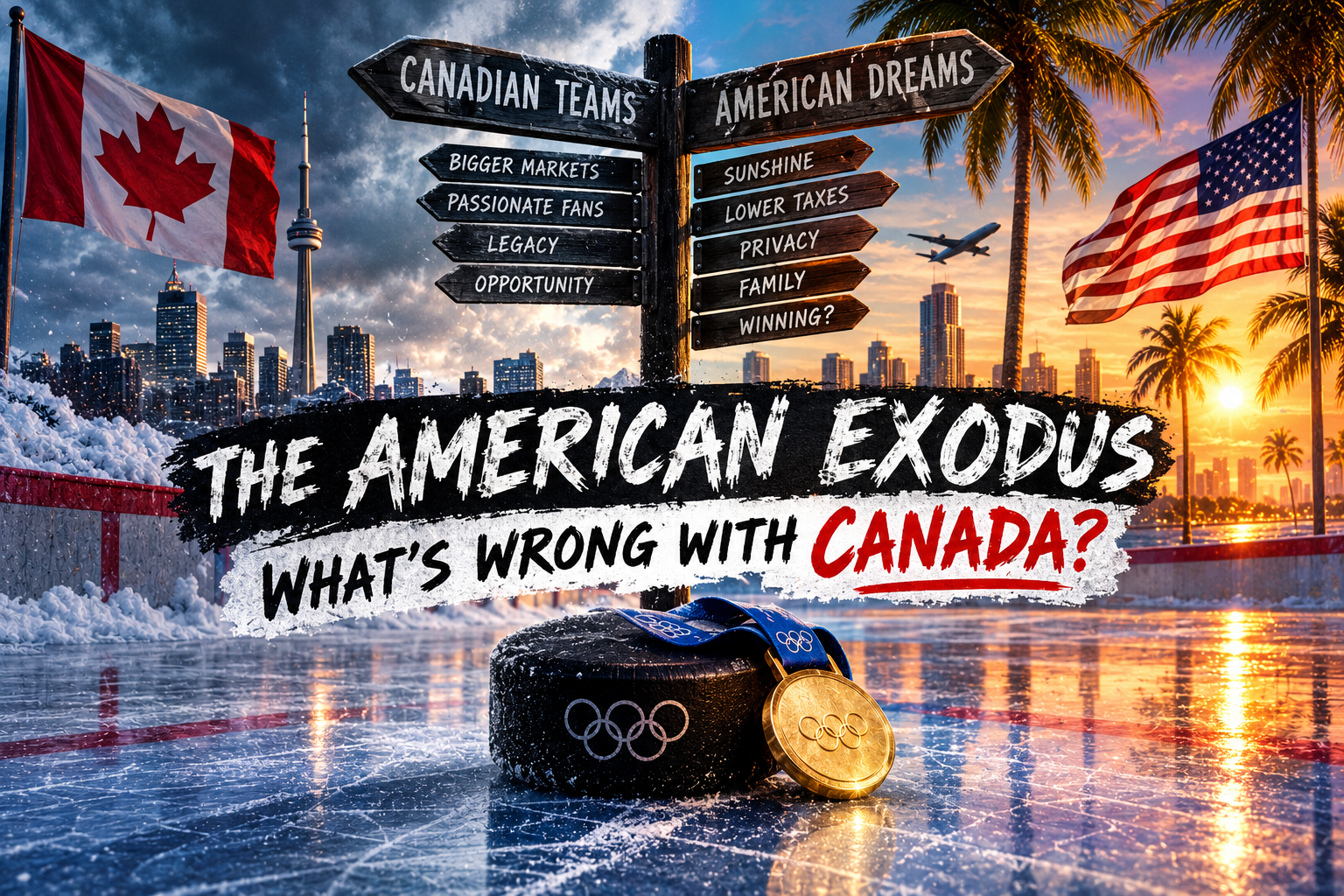
What’s wrong with Canada?
Quinn Hughes: The First Domino
Before the gold medal, before the trade requests, there was Vancouver.
Quinn Hughes was the best Canuck of his generation. He wore the C, won the 2024 Norris Trophy and put up a career-high 92 points in 2023-24 while leading Vancouver to the top of the Pacific Division. When the end came, the organization itself called him one of the greatest Canucks of all time.
The warning signs came early. After the Canucks missed the playoffs in 2025, Jim Rutherford admitted that keeping Hughes might not come down to money at all, but to his desire to play with his brothers, Jack and Luke, in New Jersey. Rutherford even said it would be easier to keep Quinn “if we brought his brothers here.”
By December 2025, the Canucks were dead last in the NHL, Hughes was a year and a half from unrestricted free agency, and the front office knew he couldn’t be swayed to stay long-term. On Dec. 12, they traded their captain to Minnesota for Marco Rossi, Zeev Buium, Liam Ohgren and a first-round pick. Rutherford later admitted he’d known for some time that Quinn wasn’t staying.
Two months later, Hughes was standing on the ice in Milan with a gold medal around his neck as a member of the Minnesota Wild. He recently said his “two feet are planted in Minnesota,” but he still hasn’t signed an extension, and the dream of playing with his brothers hasn’t gone anywhere.
In fairness, Hughes never publicly demanded a trade, and wanting to play with your brothers is about as human as it gets. But for Vancouver, the result was the same one Ottawa would get six months later: a captain and franchise cornerstone, gone south of the border.
Brady Tkachuk: Fully Committed, Until He Wasn’t
Brady Tkachuk wasn’t just a Senator. He was the Senator. Fourth overall pick in 2018, captain at 22, the youngest in franchise history, and the snarling face of a rebuild that finally dragged Ottawa back to the playoffs two springs in a row. In 2021, he signed a seven-year, $57.5-million deal.
Then came Milan, and gold alongside his brother Matthew.
On April 25, Carolina finished off a first-round sweep of the Senators on its way to the Stanley Cup. Four days later, a visibly annoyed Tkachuk told reporters he’d answered the questions about his future hundreds of times, that the rumours had become a distraction, and that he was “fully committed to this team, to this city.” His GM, Steve Staios, had already called the speculation nonsense.
On June 21, less than two months later, Tkachuk was a Florida Panther.
Staios didn’t sugarcoat it: “What changed was a trade request.” It came about a week after the season ended. Tkachuk held a no-move clause and handed Ottawa a four-team list of Florida, Carolina, Vegas and Minnesota, but by the end everyone knew there was only one real destination. Ottawa got three first-round picks and a second for its captain.
I get the brother thing. If I had the chance to play pro hockey with my brother, I’d jump at it too. And Florida had just won back-to-back Cups in 2024 and 2025.
But put yourself in a Sens fan’s shoes. Your captain looks into the cameras in late April and tells you he’s all in. A few weeks later, he’s holding up a jersey in Sunrise. In September, Tkachuk called it an emotional, agonizing decision and said some of the narratives out there weren’t completely true. Fair enough. But when Thomas Chabot, his teammate for eight years, said “You want guys to want to be here,” every fan in Ottawa felt it.
“The Majority of the League Doesn’t Feel the Same Way”: Connor Hellebuyck
If Brady’s exit stung Ottawa, Hellebuyck’s gutted Winnipeg.
This was a fifth-round pick who became the best goalie on the planet: three Vezinas, the 2025 Hart Trophy, and the backbone of a Jets team that won the Presidents’ Trophy in 2024-25. In 2023, he signed a seven-year, $59.5-million extension, betting that Winnipeg could win.
In Milan, he was the tournament MVP, stopping 41 shots in the gold-medal game against Canada.
Then Winnipeg fell off a cliff: 35-35-12, out of the playoffs a year after finishing first overall. On April 17, Hellebuyck called the season unacceptable. Asked about Winnipeg’s appeal, he said he’d made the city his home and liked it there, but that “the majority of the league doesn’t feel the same way.”
Read that again. That’s not a rival GM or a radio caller. That’s the franchise’s best player telling you, out loud, what the league thinks of your city.
On Aug. 27, he went public, revealing that he’d privately asked for a trade months earlier. He didn’t report to camp. The Jets suspended him, he forfeited nearly $928,000 in salary, and Winnipeg finally shipped him to New Jersey on Oct. 23.
His first message as a Devil? “Just being in the USA will be very exciting.”
In fairness, Hellebuyck never told us exactly when that private request happened, so we can’t say whether his April comments came before or after it. But he told us plenty.
Ten Teams, Zero in Canada: Dylan Larkin
Larkin’s case is different because he’s leaving an American team. That’s exactly what makes it so revealing.
Shortly after the season, his agent called Steve Yzerman to ask for a trade. The Red Wings haven’t played a playoff game since 2016, and at 30, Larkin wants to win. I have no problem with that. Detroit stripped him of the captaincy before training camp.
His original list had three teams: Florida, Minnesota and Vegas. By late October, it had grown to ten. Not one of them is in Canada.
Not even Montreal, a team coming off a run to the conference final, whose fans chanted “We want Larkin!” at the Bell Centre on Oct. 10. Larkin called the moment “interesting.” He still didn’t add them.
Larkin has never said he won’t play in Canada, and I’m not going to put words in his mouth. But if winning is the whole point, why does every Canadian team, including one that just played in the conference final, get crossed off before the conversation even starts?
The Olympic Question
This is where the timing gets impossible to ignore. The U.S. won gold on Feb. 22. Within months, Tkachuk, Hellebuyck and Larkin had all asked out. Add Hughes, who was already gone, and that’s four of the biggest stars from one gold-medal roster leaving, or trying to leave, the teams that built around them. Three of those teams are Canadian.
The players don’t agree on what it means. Zach Werenski has talked about how gold reminded him what winning feels like, and how a Stanley Cup is the one thing missing from his resume. Jack Hughes, the guy who scored the golden goal, doesn’t believe the Olympics caused any of this.
Here’s my take. Nobody sat in that dressing room in Milan planning an escape route. But spend a few weeks winning alongside the best American players alive, and maybe you go home and see your own situation differently. Maybe you start asking whether your team will ever give you that feeling again. And maybe, when you answer that question, the border starts to matter.
I can’t prove the Olympics caused these exits. I’m not going to ignore the timing either.
We’ve Seen This Movie Before
To be fair, American stars leaving Canadian teams isn’t new.
Johnny Gaudreau, Calgary to Columbus, 2022. He’d just put up 115 points for a division-winning Flames team and chose Columbus in free agency to be closer to home and family. He spoke warmly about Calgary until the end. When Team USA won gold in Milan, they brought his kids onto the ice to celebrate with them. Rest in peace, Johnny Hockey.
Matthew Tkachuk, Calgary to Florida, 2022. Coming off 104 points and a 50-win season, he told the Flames he wouldn’t sign long-term. Calgary traded him to Florida, where he signed an eight-year deal and won two Cups.
Adam Fox, a Calgary draft pick who never became a Flame. His rights went from Calgary to Carolina, and he ended up with the Rangers, the team he grew up cheering for, without ever signing in Canada.
Jacob Trouba, Winnipeg, 2016. He asked for a trade to get a bigger role on the right side and said it had nothing to do with the city. The Jets moved him to the Rangers in 2019.
Calgary lost two superstars in one summer. That’s brutal. But those exits were spread over years, with different reasons. What we’re watching now is a cluster: teammates from one gold-medal team, all on their way out within the same year.
What’s Actually Wrong With Canada?
Let’s get uncomfortable.
Taxes. Florida, Texas and Nevada have no state income tax. Canadian players pay federal and provincial tax, and on an eight-figure salary that gap is real money. Road-game taxes muddy the math, but nobody’s pretending it’s a wash.
Weather. I live in Edmonton. I know what January looks like. Winnipeg, Calgary, Ottawa, Montreal and Toronto aren’t exactly selling sunshine.
The spotlight. This might be the biggest one. Lose three straight in Toronto and sports radio has three different theories about the dressing room by lunch. In Montreal, hockey is religion. In Edmonton, Connor McDavid can’t buy groceries in peace.
And here’s the strange thing about hockey. An NHL superstar can almost hide in plain sight. LeBron James has lived under a national microscope since high school. McDavid, the best hockey player in the world, gets a fraction of that attention. Play in Raleigh, Las Vegas or Sunrise, and you can make $10 million a year, win, and still push a cart through the grocery store without anybody stopping you.
For a lot of players, that’s the dream.
It’s not mine. I live in Edmonton, so I’m probably supposed to say the Oilers. But if I ever got the call, I’d want Toronto. I’d want my name on jerseys in the stands, the pressure, the noise, the whole country losing its mind over one game in November. I’d want to be famous for playing hockey.
Maybe that’s just the Canadian in me.
From One Heartbroken Fan Base to Another
I’m a Leafs fan, so let me say this to every fan base in this country that’s watched its star walk out the door: I know exactly how that feels.
On July 1, 2025, Mitch Marner left. A kid from the GTA who grew up in blue and white, after nine seasons as a Leaf, was signed and traded to Vegas. His reasons weren’t “Canada bad.” He’s Canadian. To me, it was the pressure, the noise, the fishbowl, and honestly, a fan base that didn’t always make it easy on him. I understood it. It still hit me right in the chest.
So to Canucks fans who watched their captain get shipped to Minnesota before the puck even dropped in Milan: I see you. To Sens fans who heard “fully committed” in April and watched the press conference in Sunrise in June: I see you. To Jets fans who built their winters around the best goalie on Earth, only to watch him skip training camp rather than come back: I see you. And to Flames fans who lost Gaudreau and Tkachuk in the same summer: I see you too.
Now let me be honest about the scenario that keeps me up at night.
Auston Matthews’ contract runs through 2027-28. If he ever walks for sunshine and no state income tax because Toronto was too cold, too loud, too Canadian, I won’t be disappointed. I’ll be furious.
Because this isn’t a one-way street. We buy the jerseys for our kids. We pay ridiculous prices for tickets. We defend these guys on sports radio after every playoff exit. We turn them into household names in a country that treats hockey like a birthright. If the answer after all that is “anywhere but here,” that’s not a business decision to me. That’s a rejection.
For now, Matthews has said “My intent was always to be here.” I believe him.
But Ottawa believed Brady too.
Ungrateful, or Just Gone?
It’s easy to call these players ungrateful. I won’t. Brady thanked Ottawa. Hellebuyck thanked Winnipeg. Players have families and short careers, and they’re allowed to choose what’s best for them.
But Canadian teams are allowed to wonder if they’re starting at a disadvantage. You draft a kid, develop him, market him, hand him the C, and the whole city buys in. Then one day he decides he wants something else, and you start over.
Some of this is on the teams, too. Hellebuyck’s real complaint wasn’t Canada. It was whether Winnipeg could convince anyone to come help him win. Vancouver couldn’t build a winner around Hughes either. A player can love a city and still lose faith in the hockey club. Build a winner, and a lot of these conversations never happen.
And not every American wants out. Werenski turned down a trade to Dallas and said “This is where I want to be” in Columbus. Jake Sanderson signed an eight-year, $64.4-million extension in Ottawa in 2023 and is still a Senator. Matthews, for now, is staying put.
So it isn’t every American star. But it’s enough of them, in a short enough window, that we should be paying attention.
Final Thoughts
There’s no single answer. Some players want to play with family. Some want a better shot at a Cup. Some want warmer winters, lower taxes or a quieter walk to the car after a loss. Some just want to live in the United States, and that’s their right.
But the timeline is the timeline. Hughes gone in December. Gold in February. Tkachuk gone in June. Hellebuyck gone in October. Larkin’s list: ten teams, zero in Canada.
Is it an exodus? Maybe that’s a little dramatic. Is it a pattern? I think it is.
Canadian fans carry these teams through rebuilds, lottery years and playoff heartbreak. We spend money we probably shouldn’t on tickets and jerseys. We turn these players into legends. So when some of the biggest American stars decide they’d rather win anywhere but here, we’re allowed to ask why.
If I ever got the chance, I wouldn’t be looking for the quietest market with the warmest weather. I’d want the biggest stage, the most pressure and the most passionate fans in the world.
I’d want to play in Canada.
So seriously: what’s wrong with Canada?
Sources: NHL.com, The Canadian Press, Associated Press, TSN, Sportsnet, ESPN, The Athletic, CTV News, CP24, The Hockey News, Daily Faceoff, Bleacher Report, theScore, Field Level Media, CanucksArmy