
There comes a point when a player stops needing to prove he belongs among the best and starts forcing everyone to explain why he isn’t being recognized as one of the best. For Edmonton Oilers defenceman Evan Bouchard, that conversation is becoming increasingly difficult to ignore.
Bouchard has established himself as one of the NHL’s most dangerous offensive defencemen, a player capable of changing a game with one pass, one shot from the point or one perfectly timed offensive-zone activation. Yet despite producing at an elite level, questions remain about what it will take for him to receive hockey’s highest individual recognition for a defenceman: the Norris Trophy.
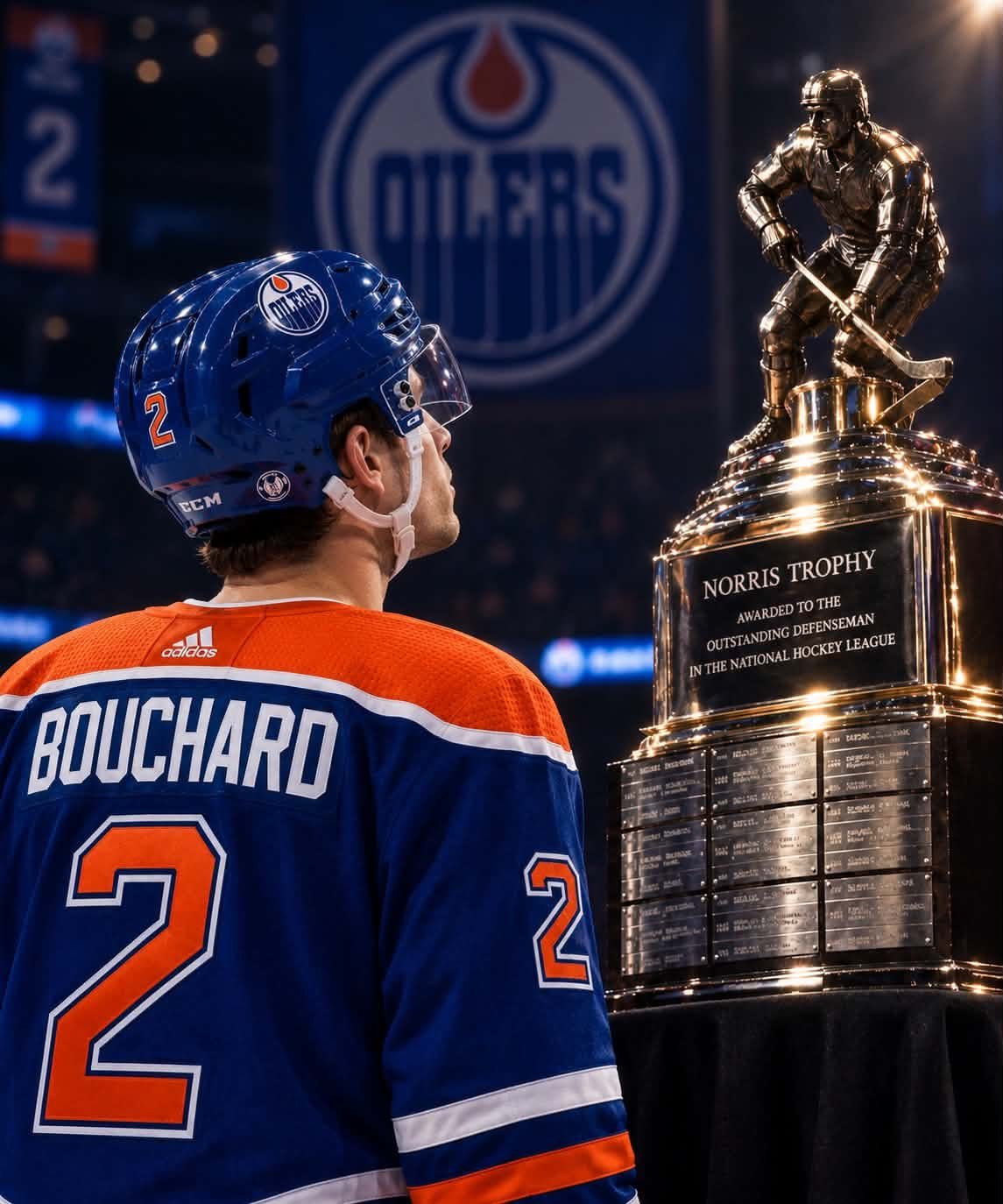
Last season, Bouchard delivered a remarkable 95-point campaign, an achievement that placed him in rare company among NHL defencemen. For a player quarterbacking the Edmonton Oilers’ power play and playing alongside some of the league’s most dynamic offensive talent, those numbers were impressive even by the standards of an organization built around generating offence.
But when the Norris Trophy conversation concluded, Bouchard was left without the award.
That raises a legitimate question: If a defenceman can produce 95 points in a season and still fall short of winning the Norris Trophy, what exactly does he need to do to get over the finish line?
95 points, but still no Norris Trophy
Bouchard’s offensive production is not a fluke. His vision, passing ability, confidence with the puck and heavy shot have made him an essential part of Edmonton’s attack. He is not simply a player who benefits from sharing the ice with Connor McDavid and Leon Draisaitl. He is also a major reason the Oilers can turn a power-play opportunity into a scoring chance before the opposition has time to settle into its defensive structure.
His ability to distribute the puck from the blue line is exceptional. Bouchard can thread passes through tight defensive coverage, find shooting lanes that other defencemen might not recognize and deliver the puck with the kind of precision that makes Edmonton’s elite forwards even more dangerous.
The 95-point season should have strengthened his case as one of the league’s premier defencemen. It demonstrated that his offensive ceiling is among the highest in the NHL and that his contribution to Edmonton extends well beyond simply moving the puck out of its own zone.
However, the Norris Trophy is not officially awarded to the defenceman who scores the most points. It recognizes the player judged to be the NHL’s best all-around defenceman during the regular season.
That distinction matters.
Voters consider offensive production alongside defensive reliability, consistency, minutes played, difficult matchups and a player’s overall influence on winning hockey games. A defenceman can be spectacular offensively, but if voters believe another candidate offers a more complete game, the point totals alone may not be enough.
For Bouchard, the challenge is no longer proving he can produce offence. It is convincing voters that his complete game deserves to stand above the competition.
A hot start puts Bouchard back in the spotlight
As the 2026–27 season gets underway, Bouchard’s hot start has once again put him in the conversation surrounding the NHL’s elite defencemen.
The early portion of a season can shape the narrative around an award race, particularly when a player begins producing immediately. Strong performances reinforce the idea that a previous breakout season was not an isolated achievement. They also create an opportunity for a player to demonstrate that he can sustain elite production while continuing to improve other areas of his game.
For Bouchard, a strong start is an opportunity to build on the foundation established by his 95-point campaign. If he can continue generating offence while showing greater consistency in his own end, he will make it increasingly difficult for voters to overlook his candidacy.
The important word is consistency.
Every NHL defenceman makes mistakes. Even the best players in the world occasionally lose coverage, make a poor decision with the puck or get caught on the wrong side of a developing play. The difference between a very good defenceman and a Norris Trophy winner is often the frequency of those mistakes, the ability to recover from them and the number of difficult situations a player successfully handles over an entire season.
Bouchard has the offensive tools. His next step is ensuring that his defensive performances receive the same attention as his offensive highlights.